
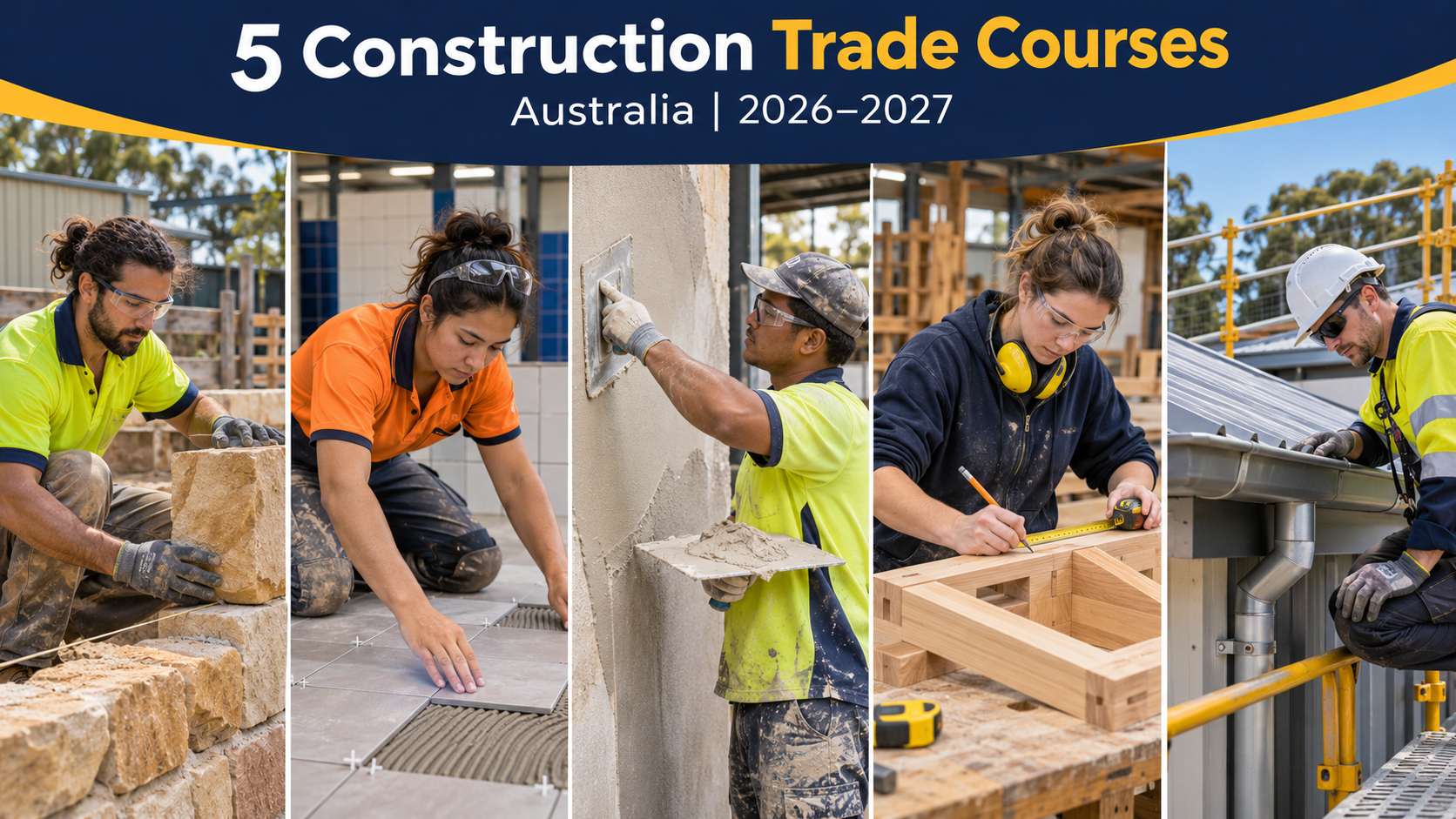
Updated 3 November 2026. Prefer practical work to a desk-based career? Construction trade study can help you develop skills used in building, renovation and specialist finishing. This guide compares five trade study areas: stonemasonry, wall and floor tiling, solid plastering, carpentry and joinery, and roof plumbing.
For international students, choosing a course means looking beyond its title. Check the training you will receive, the provider’s registration, the campus, the full cost and how the qualification fits your career plans. Migration outcomes require a separate assessment.
Five construction trade course options to explore
1. Stonemasonry — Certificate III in Stonemasonry (CPC32320)
Stonemasonry suits people who enjoy precision, craftsmanship and working with natural materials. Training can cover shaping, preparing and installing stone for building components, decorative work or heritage projects. The specialisation and units offered matter: a course focused on one type of stonework may not offer the same experience as another.
Ask the provider about workshop equipment, supervised practical tasks and the materials used in training. Review the national qualification details before comparing individual offers.
2. Wall and floor tiling — Certificate III in Wall and Floor Tiling (CPC31320)
Tiling combines careful measurement with a strong eye for detail. This qualification covers trade skills for residential and commercial tiling. Students can develop skills in preparing surfaces, planning tile layouts, cutting materials and producing consistent finishes.
When comparing courses, look at the amount of practical training and the range of wall and floor tasks covered. Tiling and waterproofing are distinct areas of work; confirm what the qualification and any local licensing rules allow you to do. See the official qualification record.
3. Solid plastering — Certificate III in Solid Plastering (CPC31020)
Solid plastering focuses on applying plaster or render finishes to surfaces. It can appeal to students who like hands-on finishing work and transforming the appearance of buildings. Practical training may involve surface preparation, mixing materials and applying finishes accurately.
Solid plastering differs from wall and ceiling lining, which commonly involves fixing sheet materials. Check the exact qualification rather than assuming all “plastering” courses lead to the same skills. Compare the provider’s course outline with the national training record.
4. Carpentry and joinery — compare the qualifications carefully
Carpentry and joinery are related trades with different training emphases. Certificate III in Carpentry (CPC30220) develops construction carpentry skills. Certificate III in Joinery (CPC31920) focuses on joinery work, including making and assembling timber components.
Consider whether you prefer building-site work or detailed workshop production. Do not assume that completing one qualification automatically qualifies you for every carpenter, joiner or combined occupation. Training content, employment duties and any skills assessment must align with the occupation being considered.
5. Roof plumbing — Certificate III in Roof Plumbing (CPC32620)
Roof plumbing concerns roof drainage and associated metal roofing work, including gutters, downpipes and related components. It is a different study area from general plumbing and roof tiling.
Ask about safe practical training facilities, work-at-height procedures and the state or territory registration or licensing requirements that may apply after training. Check the official qualification record and confirm that a suitable course is available to international students before planning an intake.
Invitation cut-off points: latest published subclass 189 round
The table below shows the minimum points scores invited in the 15 October 2026 Skilled Independent visa (subclass 189) round, as published by the Department of Home Affairs and checked on 3 November 2026. These are historical invitation results for occupations, not course admission scores.
| Study area | Occupation in the published round | Minimum points invited | Tie-break date |
|---|---|---|---|
| Stonemasonry | Stonemason | 65 | 15 September 2026 |
| Wall and floor tiling | Wall and Floor Tiler | 65 | 19 September 2026 |
| Solid plastering | Solid Plasterer | 65 | 18 September 2026 |
| Carpentry | Carpenter | 65 | 21 September 2026 |
| Carpentry and joinery | Carpenter and Joiner | 65 | 15 September 2026 |
| Roof plumbing | Roof Plumber | 65 | 20 September 2026 |
Source: Home Affairs — SkillSelect invitation rounds. The separate Joiner occupation is not represented by the Carpenter and Joiner row. Check the relevant occupation individually.
A score of 65 in this round does not guarantee a future invitation. Tie-break rules, eligibility, the nominated occupation and future selection settings also matter. This table does not describe subclass 190 state nomination or subclass 491 selection, which have their own requirements and processes.
What international students should check before enrolling
- CRICOS registration: confirm the provider, exact course and study location on the Australian Government’s CRICOS register if you intend to study on a student visa.
- Entry requirements: obtain the provider’s current English, academic and other admission requirements in writing.
- Duration and total cost: compare tuition, tools, materials, protective equipment and other charges. Fees and course length vary by provider and delivery arrangement.
- Practical training: check attendance, assessment arrangements, facilities and whether any workplace component is included or must be arranged separately.
- Career requirements: confirm licensing, registration, construction induction and employment requirements for the work and location you intend to pursue.
Can a trade course support a skilled migration plan?
A relevant qualification may form part of a longer pathway, but graduation alone does not establish visa eligibility. Your qualifications, employment, skills assessment, English and other visa requirements need to be considered together.
For eligible international VET graduates, Trades Recognition Australia’s Job Ready Program is an employment-based skills assessment with a minimum 12-month duration. It has separate eligibility rules and is not available for every trade occupation. Confirm the assessment pathway for your circumstances before relying on it in a study plan.
Find a trade course that fits your goals
Study Choice can help you compare course options, locations, entry requirements and provider information. Tell us your current qualifications, preferred city and the type of work you enjoy so we can help you explore suitable study options.
Request your free study options consultation, email info@studychoice.com.au or call +61 3 7067 3376.
This article provides general education and migration information current at the date shown. Course availability, admission, employment, skills assessment, licensing and visa outcomes are separate matters. No course guarantees employment, an invitation or permanent residence. Seek individual migration advice from a registered migration agent or Australian legal practitioner where needed.